- Cybersecurity, Government Contractors
5 Questions to Ask Before Hiring a Cybersecurity Provider for Your Government Contract
- Don't Sign Anything Until You've Asked These
- Inforsys LLC
Hiring a cybersecurity provider feels straightforward until you’re sitting across from a vendor who uses terms you’ve never heard, promises things that sound comprehensive, and hands you a proposal that doesn’t mention your contract requirements once.
For small government contractors, choosing the wrong cybersecurity provider isn’t just a bad business decision. It’s a compliance risk. The right provider protects your contract. The wrong one gives you a false sense of security, right up until your next audit.
Before you sign anything, ask these five questions. The answers will tell you everything you need to know.
Question 1:
Do you have experience working with federal government contractors specifically?
This is the first filter and it eliminates a lot of providers immediately.
General IT and cybersecurity vendors know how to secure networks. But securing a network for a government contractor is a different job. It involves understanding DFARS clauses, knowing what Controlled Unclassified Information is and how it needs to be handled, and being familiar with the documentation requirements that come with federal contracts.
A provider who’s never worked in the defense industrial base will learn on your dime. That’s not a position you want to be in when a compliance deadline is approaching.
Question 2:
Can you help me document my security controls not just implement them?
A lot of cybersecurity providers are great at putting technical controls in place. Firewalls, endpoint protection, MFA, they know how to deploy these things. What many of them can’t do is help you document those controls in a way that satisfies a federal auditor.
For government contractors, documentation is just as important as the controls themselves. NIST SP 800-171 requires a System Security Plan that describes how each security requirement is addressed in your environment. If your provider can set everything up but can’t help you write that plan, you’re only halfway there.
✘ Red flag: ‘We handle the technical side, you handle the paperwork.’
Question 3:
What does your incident response process look like and how fast can you move?
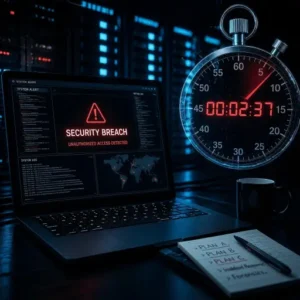
When something goes wrong and eventually something will your provider’s response speed matters more than almost anything else. Under DFARS, you have 72 hours from the time you discover a breach to report it to the DoD Cyber Crime Center. That clock doesn’t stop for slow vendor response times.
Ask specifically: what happens when you call them at 2am on a Saturday? Do they have an on-call team? What’s the average time between your first call and someone actively working on your environment? And critically, do they understand what evidence needs to be preserved before anyone starts trying to fix things?
✘ Red flag: ‘We’ll get back to you within one business day.’
Question 4:
Will you give me a complete and current picture of everything on my network?
You can’t protect what you can’t see. And you can’t answer an auditor’s questions about your environment if you don’t have an accurate, up-to-date inventory of every device, user account, and application on your network.
A lot of contractors are surprised to discover that their current IT or security provider doesn’t maintain this for them. They assume someone is keeping track. Often, nobody is.
Ask your prospective provider how they handle asset management. How often is the inventory updated? How do they handle new devices being added? What about when an employee leaves, are their accounts and access removed promptly?
✘ Red flag: ‘You’d need to track that internally’ or a vague answer about periodic reviews.
Question 5:
How do you handle the overlap between IT management and cybersecurity?
This question catches providers off guard more than any other and their answer tells you a lot.
If a provider only handles one side, IT or security, ask them directly: who manages the other side, and how do you coordinate with them? If they don’t have a clear answer, or if they’re not used to thinking about the two together, you’re looking at the gap problem that catches a lot of contractors off guard at audit time.
The best providers either handle both themselves, or have a structured, documented process for coordinating with whatever other vendor covers the other side. What you don’t want is two vendors who each assume the other is handling something, with you stuck in the middle trying to figure out who’s responsible when something goes wrong.
✘ Red flag: A confused pause, or ‘that’s really more of an IT question.’
One more thing before you decide
Beyond the five questions, pay attention to how the provider communicates during the sales process. Do they explain things in plain language, or do they bury you in acronyms? Do they ask about your specific contract requirements, or do they pitch you a generic package?
The way a provider sells is usually the way they service. If they’re already making you feel like you need a translator before you’ve signed anything, that doesn’t get better once you’re a client.
Here's what it all comes down to
The right cybersecurity provider for a government contractor isn’t just technically capable. They understand your compliance environment, they can document what they’ve done, and they can move fast when it matters.
Those five questions won’t get you all the way to a decision on their own but they’ll quickly separate the providers who understand your world from the ones who are figuring it out as they go.
Not sure where to start?
Inforsys LLC works specifically with SMB government contractors, managing IT, cybersecurity, and compliance documentation under one roof. If you’re evaluating providers, we’re happy to walk you through what a proper setup looks like for your contract environment, no pressure.
Related Posts

Penetration Testing 101: What It Actually Finds | Inforsys LLC
Penetration Testing 101: What It Is, and Why “We’ve Never Been Hacked” Isn’t Proof You’re Safe “We’ve never been hacked,

AI-Enhanced Cybersecurity: What Small Businesses Should Know
How AI Is Changing Both Cyberattacks and Cyberdefense What Small Businesses Should Know Artificial intelligence is changing cybersecurity on both